Control Resonant director Mikael Kasurinen has explained why Remedy deliberately avoids telling players exactly where to go, arguing that figuring things out for yourself is an important part of the experience.
Player guidance has become a major talking point in gaming, particularly following the release of Marvel’s Wolverine and discussion surrounding its Thought Trail navigation system.
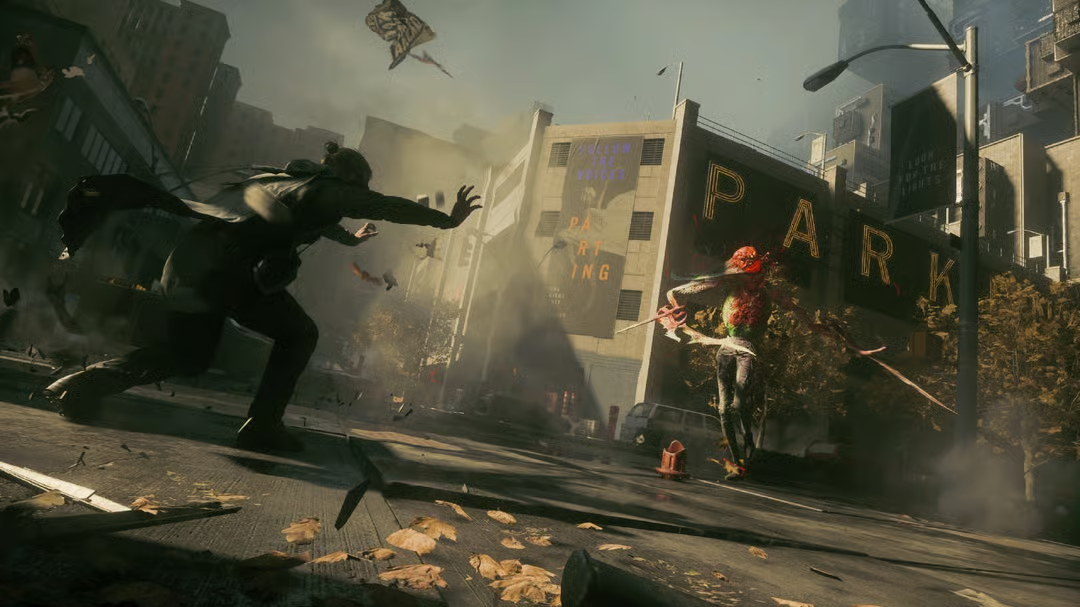
Control Resonant took a different approach. Rather than covering climbable surfaces and important routes in conspicuous paint or pointing players toward their destination, Remedy uses elements of the environment to subtly guide them.
Speaking during an appearance on Dropping Frames, Kasurinen confirmed that this "was a conscious decision, obviously."
Remedy wants players to figure things out themselves
Kasurinen explained that one of the principles behind the decision is player autonomy, which he described as giving players a genuine sense of choice rather than simply following instructions provided by the game.
“It’s not like the game is telling me what to do and I just go and do it,” he explained. “I feel like I’m the one making the decisions in the game.”
The conversation then turned to Wolverine and its controversial Thought Trail, with Kasurinen joking that he wanted to “navigate this carefully” because he didn't want to “start a feud.”
However, he made his feelings about overt player guidance clear.
“It’s so important that the players feel like they’re the ones figuring it out,” Kasurinen said.
“It has to feel like it’s on you to make a decision on what to do with those elements that you see within the world,” he continued. “If it feels like it’s like ‘go here,’ it’s not anymore a decision for the player. Somebody already decided for you.”
Kasurinen acknowledged that Remedy's approach comes with its own problems. Without obvious directions, some players can initially find Control Resonant difficult to understand.
“It can feel impenetrable. It can feel like, ‘I don’t know what to do,’” he admitted.
But that difficulty is intentional, with Kasurinen saying Remedy wants players to actively participate in figuring out how to progress rather than simply carrying out instructions.
“They can’t be outsiders who just kind of look at stuff,” he said. “They have to be there, participating in the work of figuring out what to do, that we’re not going to tell them necessarily directly.”
Kasurinen conceded that this philosophy “can alienate a lot of people really quickly” and described it as “a bit of a risky thing.”
Nevertheless, he believes it is the right approach for Control Resonant and one that could help the game “stand the test of time,” with players returning to explore and question the decisions they made rather than simply finishing a predetermined route.
“It’s not something that you kind of go through, you did what you were told, and you’re done,” he said. “It feels like, no, I made some choices in this game.”