
It took me four attempts to successfully parachute into a Wardogs match. On the first try, I opened my parachute far too early, and was promptly sniped from the sky by one of the many sharpshooters that populate Wardogs' battlefield. The second time, I pulled the ripcord far too late, pancaking into the ground like a camo-clad Wile-E-Coyote. The third time, I pulled the cord only slightly too late. But it turns out "slightly too late" has the same outcome as "very too late" when it comes to parachute jumping.
In all instances though, my skydiving failure was not the end of my game. Like many large-scale shooters, Wardogs' battlegrounds are roamed by medics looking for downed soldiers to revive. Unlike those other shooters, it allows reckless idiots like myself to incentivise medics to revive them, through offering a juicy cash bribe to anyone willing to take on the job.
This is not an isolated feature, either. Wardogs is as much about the exchange of capital as bullets, where the twin goals of factional supremacy and personal profit exist in a fragile alliance. It's an idea that, all at once, makes Wardogs stand out from the pack, slightly breaks it as a shooter, and produces a fascinating, real-time critique of late capitalism and the gig economy.
Wardogs exists at the centre of three other FPS inspirations, two of which are obvious at a glance – DICE's Battlefield series and Bohemia Interactive's more simulationist ArmA. The sole game mode is essentially King of The Hill on a massive scale, with three teams vying for control of a circular zone at the heart of a much larger map. Holding the zone for a set amount of time earns the relevant team a point. The first team to reach 100 points wins.
So far, so familiar. But it's in the Counter-Strike DNA where things start to get interesting. Each of your virtual mercenary's lives begins with a CS-style buy-phase, where you purchase your weapons and equipment using a personal pool of in-game currency. You begin the game with a bank balance of $10,000, which is just about enough to kit yourself out with a rifle, some ammo and a basic revive kit. Once you've graduated beyond the starting-player discount, however, any half decent loadout is going to cost a minimum of $4-5K.
The good news is that doing virtually anything in Wardogs will earn you cash. Killing an enemy? That's money. Assisting in an enemy kill? Also money. Reviving players? Driving them to the battlefield? Constructing bases? Money, money, money. Even idling in the control zone will provide a steady drip-feed of cash, the rate of which is doubled if you enter the far smaller, roaming circle that represents the Hot Zone.
The result of this is the kind of role-diversification you'd get in an ArmA RP server, but with profit as the motivating force. You'll see players dedicate their entire matches to ferrying players to the battlefield, or constructing elaborate fortifications around their team's Forward Operating Base. When every action has an immediate, tangible reward to it, players get involved at every level. You can even tip fellow players for doing a good job in healing you or driving you around.
This flow of capital through the match also has some interesting knock-on effects. You'll see knocked out players engage in tacit bribe wars as they strive to receive medical attention first, as well as medics racing to be the first to revive those premium-offering players.
Honestly, I could dedicate this whole article to discussing Wardogs' cash mechanic. But it's not the only thing that makes Bulkhead's FPS interesting. Wardogs' hybridisation of Battlefield and ArmA is itself noteworthy in how it manages to meld together the best aspects of both.
This begins with the maps themselves, which are huge expanses of rolling countryside. Yet unlike, say, Hell Let Loose: Vietnam, only a small amount of the map is fully utilised during a match. Most of the action is concentrated within the control zone, with the rest of the map only being used by transportation vehicles.
While this may seem wasteful, the superfluous countryside is nonetheless fundamental to contributing to Wardogs' atmosphere. On a run, I prefer to parachute in a few hundred metres outside the control zone. Partly because it's (usually) safer. But also because these areas have the same counterintuitively pastoral vibe of Bohemia's ArmA games, a depiction of the countryside that would lend itself to a great hiking simulator were it not for the whole 'War' thing going on.
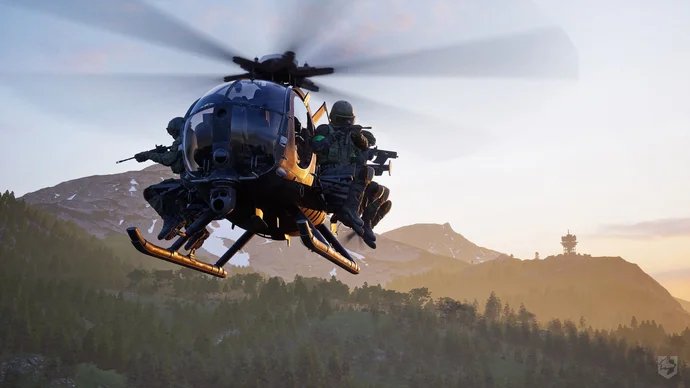
I also love how this feeling shifts as you approach the control zone, the breeze and birdsong punctuated by distant explosions and helicopters whirring overhead. Then, as you press over the threshold, you'll hear the snap of a sniper's bullet whizzing past your ear, at which point its heads down, eyes peeled, game on.
In short, Wardogs provides that slow-burn, authentic ArmA feel to warfare, but without a movement and combat system that feels like you're wading through treacle. Movement is pacey and your aim highly responsive, and while there's quite a lot of shooting at dots in the distance, the fact that the control zone tends to centre around urban areas offers frequent opportunities for CQB as well.
Indeed, if you have your own squad or follow one around (which is highly recommended for any Assault player), you'll often find that one feeds into the other. There's a very natural flow to Wardogs' combat, a lot of tentative forward pushes, holing up as you try to oust a sniper from his nest, and diversions as you try to help a fallen player or chase the Hot Zone as it relocates.
It's worth noting that this freewheeling nature also applies to roles and progression as well. There's no class system in Wardogs. Instead, progression and unlocks are governed by the weapons and items you use. There's nothing stopping you from taking an assault rifle into battle for Assault XP, while earning medic XP from your defibrillation pads, or chipping away at Support XP with a building hammer or vehicle repairing wrench.
There are also just lots of neat little touches. When you're building a fortification, for example, little yellow crosses will appear on the structure, hitting which will massively boost the build speed, turning construction into an ad-hoc game of whack-a-mole. Wardogs is also one of the most rewarding games to play as a spotter, as using binoculars to identify enemy aircraft, distant snipers and so forth nets you a cash reward.
It's a captivating, fresh approach to multiplayer FPS, and it's little wonder that it's garnered so much attention. But currently Wardogs does have one big issue, which is that actively trying to win the game is also the least rewarding way to play.
When you enter the control zone, you do so at a considerable financial deficit, so charging into the fray is a good way to drain your bank account (especially if you are, say, nearing forty and have the reflexes of a particularly sleepy koala). So the wise thing to do is just…hang back for a bit, using that time to spot enemies, assist in building a base, or do anything that de-risks that initial investment.
This in itself is fine, and Wardogs' battlefields are such that sitting back and watching things unfold is enjoyable in itself. But since being killed is the only way you can lose money, any player with half a brain will quickly figure out that the best way to make cash in Wardogs is to avoid combat whenever possible. At the most extreme, you'll see scenarios where your team's FOB is crammed with people playing as snipers or builders or drivers dropping off supplies, while the Hot Zone wanders around almost completely uncontested.
It's a fascinating flaw, to the point where calling it a flaw feels like an oversimplification. It feels almost a social experiment. Through its cash mechanic, Wardogs fragments and individualises the win condition of what would otherwise be a team game, and as such, there's less reason to care about whether your side emerges victorious so long as you personally profit.
While this might cause problems from a pragmatic perspective, thematically, it's kind of ingenious. Because of course a bunch of mercenaries are only going to do whatever actions benefit them most. In isolated instances the relationship may be symbiotic, but everyone pursuing their own goals makes directing them to a single, overarching one difficult to achieve. And for a certain, cynical kind of mindset, it's downright satisfying to play the game by actively not playing the game.
To be clear, Bulkhead does try to give players reasons to push their team to victory. Winning teams receive a substantial end game cash bonus, for example. But a 20k win bonus doesn't seem so tempting when you can comfortably make double that by sitting at the back building your little base.
No doubt, Bulkhead will spend much of its early access development tweaking and toying with Wardogs' various systems. But despite and even perhaps because of these issues, I've already had a ton of fun with Wardogs. In what has been a tough year for competitive shooters, Bulkhead's game is a jolt of electricity that's brought it gasping back to life, and I was more than happy to slip it a few quid for the privilege.
A copy of Wardogs was provided for this review by Team17.