The way RPGs handle religion is something of a meme. Are bad things happening? Might want to see what the local bishop is getting up to. An evil organization is oppressing the masses? It's probably the church. You should go kill god while you're saving the world, just to be on the safe side. Bandai Namco's Tales series, Breath of Fire, sometimes Falcom's Trails series — these and a whole lot more use religion as an easy caricature for villainy, liberally borrowing iconography and concepts from real-world doctrine to lend a sense of legitimacy to their stories.
The connection between religion and JRPGs is a bit of a trope by now, and not a great one. So I was surprised to see how seriously Fire Emblem: Fortune's Weave tackled religious topics — and how effectively it implemented real-world ideas to make a strong narrative point.
[Ed note: This piece contains mild spoilers for parts of Dietrich's path and tones of Part 3 in Fire Emblem: Fortune’s Weave.]
Developer Intelligent Systems has toyed with religious and mythological symbols in Fire Emblem over the years, mostly the latter and typically just when something needed a cool-sounding name. Three Houses' Church of Seiros was an exception, a hierarchical religion that relied on ritual, liturgy, and faith — and abused its position — to maintain order. It's not a bad setup, and Seiros is a wonderfully complex villain. But you could swap her and her church for any oppressive institution and get the same outcome: an oppressive institution that Edelgard wants dead and buried.
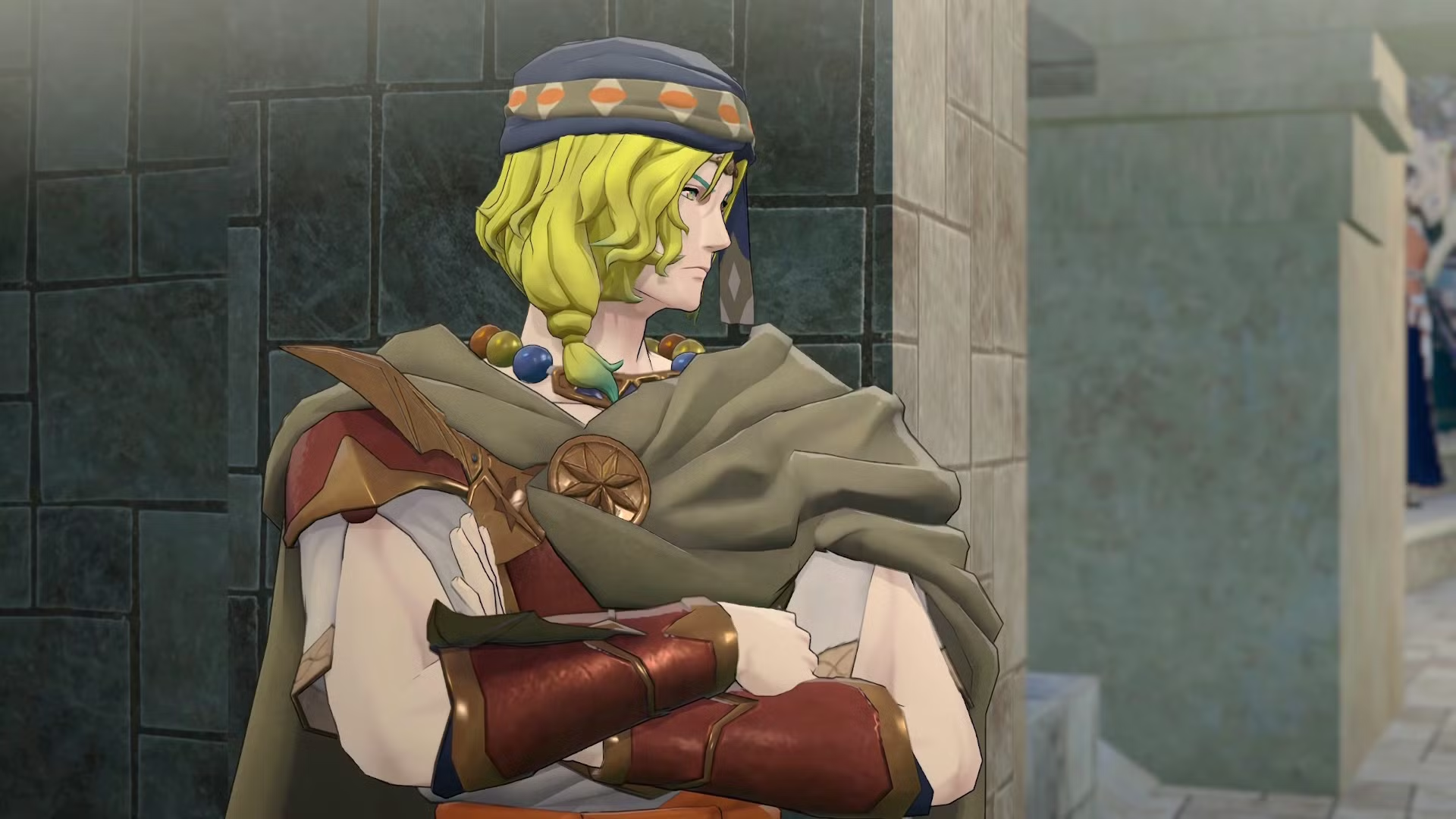
I realized Fortune's Weave was doing something much different toward the end of Dietrich's route (which you really should play if you haven’t yet). The incident is brief and happens when Fabio, a key ally of Dietrich, explains the origin and workings of Crest Stones. Those are the items from Fire Emblem: Three Houses that conferred supernatural powers on whoever had them, power that eventually drove the bearer to madness and turned them into monsters.
Maybe it was remiss of me, but I never felt the need to know how Crest Stones worked. It's a magic dragon rock. That's kind of an explanation in itself, and video game logic operates on rules similar to those espoused by philosophers in Terry Pratchett's Discworld books: Things just happen; what the hell.
Well, Intelligent Systems decided this thing needed a proper explanation and went all out.
"The very structure of the Crest Stones is truly shocking," Fabio says. "They contain a conduit to hyperspace."
This is a lot to take in. The magic dragon god rocks are actually scientific space rocks, a slightly niche reference to a small note from Three Houses about Sothis having descended on the world from outer space. But there's more, which is where things get interesting.
"A conduit for the transfer of matter making up a dragon's body and the energy to animate it," Fabio adds.
Get Polygon’s Wishlister newsletter
A weekly cheat sheet to what you’ll eventually love to play. No buying, no commitment — just saving for later.
Free. Unsubscribe anytime.
In other words, the Crest Stone takes divine energy from outer space and transforms it into something that elevates the humans it touches into something beyond their base natural condition. Maybe it's just me, but that sounds a whole lot like the Roman Catholic doctrine of transubstantiation. It's a belief that priests conducting mass have the power to transform bread and wine into the body and blood of Christ, melding the divine and the human in an act of communion.
It's not a 1:1 parallel, of course. My dad's parents are devout Roman Catholics, and they've yet to turn into magical monsters just from taking Mass, the way Crest Stones eventually corrupt humans. Tempting as it may be to view Fabio's comment as another, slightly more specific, off-the-cuff reference to real-world things, Intelligent Systems is being very intentional with its references.
Look at the situation with the People of the White Egg, how Dagda brutally murdered thousands of them out of fear, and how it loosely resembles Rome's brutal conflicts with the Carthaginians in the second and third centuries BCE. Historians then and now regard those unnecessarily punitive as a turning point in the history of Rome's collective moral character. In Fortune's Weave, the Dagdan pantheon regards the genocide against the People of the White Egg as a turning point toward paranoia and cruelty in Dagda the Great's rule over the country of Dagsion. If you doubt the connection there, there's a Grand Megalith, one of those high-tech underground you visit in Dietrich's route named Hannibal, who rides an elephant. In real life, the Carthaginian general Hannibal was famous for leading an army of elephant riders over the Alps to attack Rome. These aren't just cool-sounding names and neat ideas. Intelligent Systems has a purpose for them.
This draconic version of transubstantiation mirrors the real-world belief in a way that supports Fabio's faith the same as communion supports Catholic faith. Granted, Fabio's version of it would be blasphemy in real life, but still He despises the gods like a good Agarthan, but he's not too happy with his own people, either. Humans wanted the power of the gods to better themselves. Agarthans gave them the power of the gods as an act of vengeance. Neither path sits right with Fabio anymore.
He and, as you eventually learn, the less psychotic members of the Dagdan pantheon, want a world where people aren't dependent on gods, where they don't define themselves based on their relationship with the divine. It's the same conclusion the wandering drunk monk Yang Jie arrived at after years of devotion and doubt, which makes him joining Dietrich's crew as the automatic recruit a nice little touch. For them and even the gods, faith and heresy aren't the defining factors of a future worth fighting for. Such a future leaves no room for those concepts, or the past will just keep repeating (as we see it does in Three Houses).
Self-sufficiency is hardly an original message. The thematic unity and the thoughtful use of religion to underscore a point is highly unexpected, though, particularly in a medium too scared to acknowledge religion or too shallow to do anything worthwhile with it. It's a rare and welcome step forward — for the series, and for the genre.